
Standing in the Forex Queue
A lesson in hypocrisy that is best enjoyed whilst listening to "Hypocrite" by Falz ft Demmie Vee - https://open.spotify.com/track/0iGSDotfsjYytercwrijcB?si=2a0cfeaf40564642

People just dey do like say dem no dey shit
People just dey do like say dem no dey breathe o
At some point over the past five years, I earned in the forex. I worked as an Editorial project manager, and I was on cloud nine. With earnings in forex came a few privileges, one being that whenever I visited the bank to withdraw my money, I was more often than not treated with some reverence; from the security guard who would greet me profusely and throw a salute for good measure to the forex cashier whose smile would go up a few notches when she saw my face, even if I was standing all the way at the back.
And I rarely stood all the way at the back. As one would expect, forex earners aren’t a staple in Nigeria, even with the rise of globalization. I rarely went to the bank at the end of the month to find a long queue. But on days when there was one, I’d be signaled by the cashier to come forward. I’d walk past dour-looking faces on the other side of “regular” naira lines as they watched me head to the front of the line, smile, be handed a withdrawal slip, and right there fill it in to get my money. I have never been one to think of myself as deeply hypocritical, but I am self-aware enough to realize that with a certain earning power comes a certain bit of privilege.
As time passed, I reveled in the privilege. As opposed to rushing off to the bank in the morning, I now had the inbuilt levity to get there at, say, 4 pm, knowing fully well that as long as there was forex cash, I’d be granted entrance and my transactions approved. I never considered it anything more than what it was—a privilege—until life happened.
I lost my job.
I stopped earning in forex.
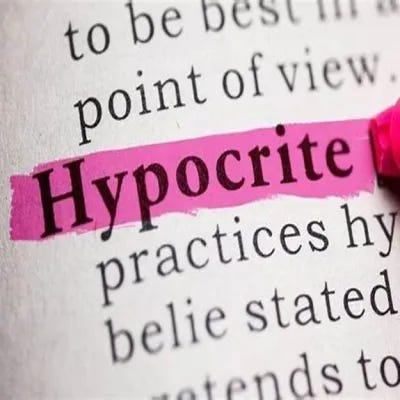
The Theory Of Accepted Hypocrisy
The point of this story isn’t about earning in forex or earning privilege. Instead, it is about something a lot more sinister, but doused in mundanity, it has become commonplace: accepted hypocrisy.
Accepted hypocrisy is the act of normalizing the feeling and privilege that an unfair advantage offers you so much that you begin to see and believe such unfair advantage as a right, beholden to you alone.
In 2019, Nigerian rapper and actor Falz released a song on his fourth studio album, Moral Instruction, called “Hypocrite.” The album, lauded for its topical references to social injustice, police brutality, and prostitution, was a masterpiece in artistic dexterity. The aforementioned song in particular was one that I was truly fond of.
In it, he lambasts politicians, the clergy, voter apathy, purity culture, and lots more. The song speaks to our tendency to say one thing, claim to believe one ideal, and then act in total opposition to what that ideal stands for.
Falz raps, “Pastor wey dey do like say he no be sinner, See the spec in your eye no dey point finger.” These lyrics felt pointed at the clergy, but the more I listen to it, the more I am faced with one simple truth: the song is about me.
By definition, to be “hypocritical” is to behave in a way that suggests one has higher standards or more noble beliefs than is the case. Being hypocritical isn’t necessarily evil. It is almost as human as having a sense of self. We cannot all mean what we say and say what we mean. We are flawed, and that is expected and even lauded to a certain degree. However, an issue arises when our privilege blinds us from acknowledging it.
The example of my forex earning days doesn’t make me a terrible person for enjoying the privilege of not standing in a long queue. But my sense in seeing that as normal or expected is where I have to call myself to question.
The Do You Know Who I Am? Syndrome
The other day, in a random conversation with a friend, she noted that she feels like she’d be a terrible person if she had all the money in the world that suited her needs. I agreed and even spoke to how, in my head, I know that with just the right amount of disposable income, I would probably be the sort of person to indulge in a lot of the vices that ordinarily, I’d be quicker to turn my nose up at currently.
The beauty of that exchange with my friend was that in that moment, we were self-aware. Yet, if the tables did indeed turn the next day and I had that disposable income and indulged in the supposed vices, some part of me would find it hard to reconcile why that action is a bad thing as opposed to accepting it as normal.
During my forex earning days, not once did I feel the need to say no to the cashier when she asked me to move past the queue and come to her and fill out my withdrawal form. In fact, after a few months, I began to expect it. This brazen expectation was perfectly encapsulated when the cashier I was familiar with was transferred to a different section in the bank, and someone new was at the desk. I got frustrated with the wait.
I even went as far as subtly trying to establish a rapport with the person by mentioning, in passing, that I usually came to get this said amount every month. I remember the smirk on the cashier’s face as though saying, “Not sure how that information matters to me.” I felt hurt. I felt a certain disdain for the person, not because they did anything wrong, but because, for some reason, I felt like they ought to have acknowledged my privilege.
Only in retrospect and true introspection are we rarely able to catch the depth of our own accepted hypocrisy. Most times, it hits us only after a sudden change in our circumstances, like me, losing my job and no longer earning in forex. Other times, it is the absence of a certain expectation from people we genuinely believe we might be better than.
Everybody Is Rich And A Saint Here
As a tangent, I realize that whilst earning in forex, deep down, I may have genuinely thought that I was somehow better off than the cashiers who helped process my cash withdrawals. I would often crumple up a few banknotes and toss them into the side of their desk after I was done changing the forex, trying (and failing) to avoid the camera that looked in on them, and walking out of the bank feeling like I had contributed positively to someone’s life.
The moment I wasn’t able to do this anymore, it hit me that I was never better than them in any way. I was just blinded by a false sense of accomplishment that my forex earnings status afforded me. And even more so, I now realize that in more ways than one, the way the cashiers smiled and accommodated me had little to do with how much I was earning and more to do with their customer service training.
The deeply humbling thing about realizing one’s penchant for accepted hypocrisy is the double realization that it is as recurring in a lot more facets of our lives than we may have thought. It is also more deadly because we are somehow able to rationalize it as not being a big deal. And maybe it isn’t.
Maybe in the grand scheme of things, my loving the privilege of cutting in line at the bank because of my earning power doesn’t put me on the same scale as business owners who would cut corners to get less-than-ideal projects approved. Maybe I am not on the same level as those who would shout “death to the gays”, be willing to beat an innocent man to a pulp because of who he chooses to consentingly sleep with, but be quick to rush to the defense of a rapist with little or no proof of his innocence.
Maybe I am even better than our politicians and their insatiable greed for wealth and power. Maybe my small privilege inside the bank in those moments isn’t inherently as terrible as a corrupt politician being offered a deacon seat inside a church and lauded for their “Christian and prayerful values.”
My Hypocrisy Stinks Less Than Yours…I think?
In comparison, it would seem as though some of our accepted hypocrisy isn’t as doomsday alluring as one might fear it is. But I think that tiny drops do make up the ocean. And the truth is that what is accepted today —in little trickles as it might be— becomes the norm tomorrow.
Ideally, I would hope that is the case with a lot more positive actions. For example, one would hope that with the LGBTQ community, the little trickle of global acceptance they have garnered becomes the norm in the future, but with the current right-wing radicalization that is ongoing, I doubt if even that is true.
On the hook of the song “Hypocrite” featured artiste, Dennie Vee croons, “Everybody is a motherfuckin’ hypocrite o” and this remains true. But I believe that the moral instruction that song hoped to pass across is not for us to accept a flaw that is as human as human can be, but to constantly call into question our indifference toward it.
I am a hypocrite and probably would always be in my own little ways. But I would hope that as much as possible, in the quiet of my heart and self-reflections, I can confront the truth of my own dishonesty, no matter how seemingly harmless they may be.
Tiny drops do make an ocean, and I believe that we are currently in a time period where that is more evident. Rhetoric that seemed harmless despite its blatant hypocrisy has now become more pronounced and emboldened. We are at a time when spewing hate is considered “free speech” because we have come to accept the insinuation that “oh, everyone has crazy opinions, it doesn’t mean they are bad people.”
Accepted hypocrisy is dangerous not because of the hypocrisy itself, but because of the acceptance. When we normalize what is ideally harmful because we believe it affords us some privileges, we fill the ocean of humanity with more harmful byproducts than we know. And often, because it feels normalized, we never worry about it until something drastic happens. And soon, in retrospect, we are forced to confront our own complicity in the ills that continue to plague our society.